Racing Returns to Cleveland in a New Museum Exhibit
Written by Mitchell Wood

From 1982 to 2007, Cleveland Burke Lakefront Airport was a quiet, private airport designed to cater to Cleveland’s wealthiest businesspeople for 51 weeks out of the year. But for one week during the peak of summer, Burke took the planes off its sun-baked asphalt and transformed the tarmac into a ripping raceway for The Grand Prix of Cleveland.
The Grand Prix of Cleveland, an IndyCar race, was one of the city’s premier summer events. Spectators crowded the grandstands, bobbing boats packed Lake Erie’s shore and the community buzzed with excitement in anticipation of a loaded weekend full of intense, gritty racing.

The Grand Prix carried such an infectious energy that it turned event staffers into racing fanatics.
Dan Davis, a former public relations representative for University Hospitals, attended the 1988 Grand Prix of Cleveland to provide information to the media in case of an accident. He had no idea that working one weekend at the race track would kick-start his engine.
“I was there Friday, Saturday and Sunday down in the pits,” Davis, 68, said. “That set the hook for me to become a huge motorsports fan.”
Davis has since channeled his racing passion into his work at the Crawford Auto Aviation Museum in Cleveland, where he served as director of external relations before transitioning into a volunteer role.
Davis pushed for Crawford to create an exhibit dedicated to the Grand Prix of Cleveland, alongside its extensive exhibit about the Cleveland National Air Races.

In the 1920s and 30s, long before Burke Lakefront Airport hosted the Grand Prix, Cleveland was home to the National Air Races for 20 years, which attracted legendary pilots like Amelia Earhart and Charles Lindbergh.
Despite their prominence, Davis said the Grand Prix was bigger than the National Air Races.
“The Grand Prix put Cleveland on a global stage each summer,” he said. “Some of the biggest names in motorsports came to compete in the race.”
Mario Andretti, Michael Andretti and A.J. Allmendinger are three former Grand Prix of Cleveland winners who had extremely successful motorsport careers after being crowned champions at Burke.

Despite the flashy names this race attracted, the winner of the first Grand Prix of Cleveland was actually a rookie from Medina, Ohio, Bobby Rahal.
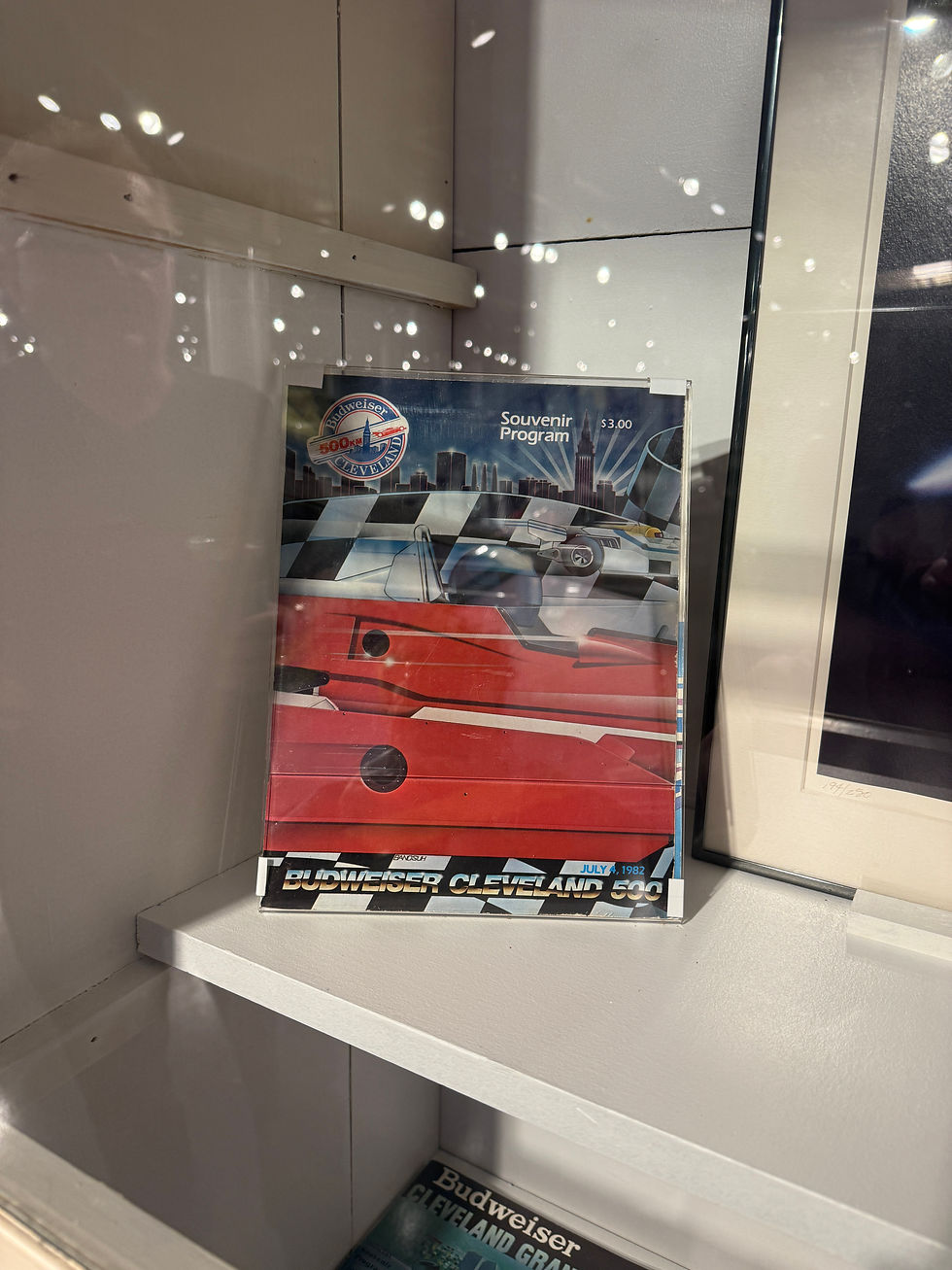
On July 4, 1982, Rahal lined up on the runway for his home race at the then-called Budweiser Cleveland-500. He beat out Andretti and many other accomplished drivers to earn his first win as a professional racer.
In 2006, 25 years after the race, Rahal told the Herald-Standard, “I could have run for mayor the next day and won.”
The Crawford Auto Aviation Museum’s new Grand Prix of Cleveland exhibit includes the 1982 Buick Skyhawk PPG pace car, Bobby Rahal’s winning car from that inaugural race.
The exhibit also features memorabilia and information about the race, race winners and team owners.
The Grand Prix of Cleveland was a true racers' race. The course's design came with many unique elements that allowed drivers to battle.
The course used the airport's wide-open design to its advantage, creating long straightaways, which led drivers to easily reach more than 150 mph and accomplish cinematic overtakes. While this sounds like a dream to most drivers, Burke’s taxiways proved to be a challenging section of the course.
“The taxiways led to rough transitions, which would give drivers blisters on their hands,” said Davis.
These treacherous sections of the course were not the only unique qualities the Grand Prix of Cleveland possessed.
Unlike Burke, many traditional street courses had concrete walls that limited drivers. Making a mistake on the lakefront meant drivers would spin out onto the grass surrounding the track, allowing them to continue to race instead of crashing into a wall and damaging their car.
The Grand Prix of Cleveland came to an abrupt end in 2007 due to the race's high operating costs, the lack of a major sponsor and a fallout between the race organizers. The Greater Cleveland Sports Commission has explored the opportunity to bring an IndyCar back to Cleveland in 2028, though that race has not yet been confirmed.
Until more news comes out about a potential IndyCar race returning to Cleveland, local race fans will have plenty of time to reminisce about those hot summer weekends at the Crawford Auto Aviation Museum’s new exhibit on the Cleveland Grand Prix.