It’s So Art Deco
My personal journey exploring Art Deco and the historical, physical representation of it that I discovered.
Written by Andrew Paduano

My Discovery
Do you ever find yourself admiring something – no, obsessing over something? Something where you think to yourself, “I need this. I want that thing to be a central part of my life?” Well that’s what happened to me this year when I discovered something called Art Deco.
You see, a little known thing about me is that I’m into horology: the study of timekeeping. Inspired by the many unique clocks around my grandparents’ house growing up, I’ve been into them ever since. I’m specifically compelled by more artistic clocks, not the common style we all know and take for granted; think Cartier watches, contemporary clocks and more abstract designs.

There is a Seiko desk clock, for example, which itself sits on a fulcrum like a sea-saw and mesmerizingly moves when touched. Recently, I built a fully mechanical pendulum wall clock made out of 100% LEGO, which accurately tells time comparable to higher-end mechanical watches. It wasn't until one casual internet search did I realize these clocks – the Lego one included – were in line with the style of Art Deco (at least I like to think). I accidentally designed a clock with a style I wasn’t even aware of. I guess it is just a part of who I am.

Art Deco, or Arts Décoratifs, emerged during the 1925 International Exhibition of Modern Decorative and Industrial Arts held in Paris, and thrived during the 1920s to 1930s. Characterized by bold geometric patterns and bright colors, mixed with rare materials and historical patterns of places such as Japan, China and ancient Egypt, the 100-year-old-style embodies the spirit of luxury and technological progress.
I also greatly enjoy modern/contemporary styles, but Art Deco has some special flare; and I want to showcase its potential to the modern world. The style is beautiful enough for exterior architecture, but its possibilities with interior design truly tickle my brain.
With near-perfect timing earlier this year, a special place was brought to my attention.
A place perhaps embodying the art like no other.
Blessed upon my senses was an online post about a unique, local building originally designed by architect Abram Garfield, son of the late president Andrew Garfield, and built in 1930 as part of the Dudley S. Blossom estate. Inconspicuously seen as an old hangar on the outside, but gracefully presenting a dream on the inside, is none other than The Hangar in Beachwood, Ohio.
I instantly wanted to learn more and experience its presence in person and, after getting in contact with the owners, Isabelle King graciously allowed me to visit the place.
The Spectacle of The Hangar
Approaching the front door, one climbs a zig-zag double staircase, emphasizing the already imposing and geometrically-intricate structure. Two window panes decorated with sharp shapes flank the door on its sides and framed in the middle is a fish sculpture, all hinting at what is to unfold inside. Walking through a small coat area, an aquatic dream is presented in the next room, framed by the doorway. A stepped-tray ceiling of bold blue sets the stage for a central chandelier. In the words of singer Lana Del Rey, the chandelier reflects “like Art Deco out on the floor — shining like gun metal, cold and unsure.”
A personification of the entire place itself, the piece bestows you with the feeling that it is almost a jellyfish-like entity, natural and shining with light, yet very industrial and bold. Plastered all over the top of the walls is a colorful mural of an underwater scene spread out, aquatic life of various shapes and sizes all swimming about. A circular portal to the underwater world is framed above a fireplace.

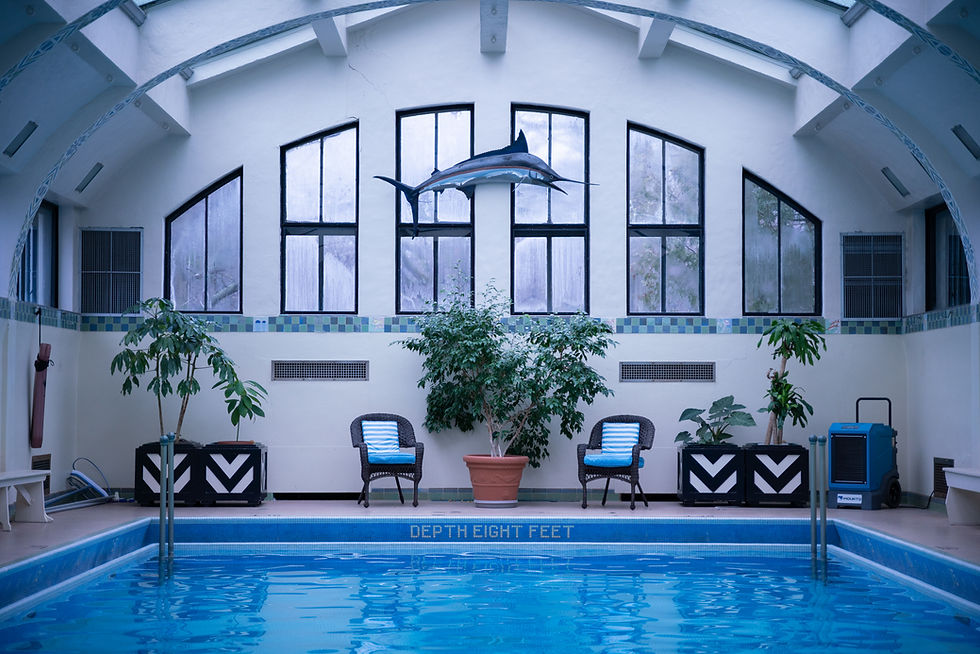
To the left is a look into a cool, long and shimmering indoor pool, decorated with detailed aquatic railing. To the right is a quiet and large tennis court, guarded with tall, sharp-shaped windows mimicking the inside of a palace. A long table sits beneath the chandelier and the room is framed on its sides by various chairs and couches, giving a way to lounge in the spectacle. Various lamps line the walls and tables, casting the entire place in a warm, dreamy glow.


Marrying it all together is a carefully implemented style of Art Deco; each piece of furniture, windows and doors are subtly or not-so-subtly adorned with geometric detail.
The entire interior is practically Art Deco. Other, smaller rooms such as the kitchen, bathroom and coat area, are all decorated just as well as the main room.

Wall vents are lavishly decorated with strong triangular shapes. A coat hangar is adorned with small swans and more geometric shapes. Even down to the small door hinges – yes, the door hinges – are decorated with Art Deco.
Some fish railings near the main room are by Rose Iron Works, a well-known company based in Cleveland whose work has been featured at The Cleveland Museum of Art. The architect also designed the home with long-lasting materials and structure in mind.
One is left to slow down and be transported into another world, to take the experience in – something not every space can so easily do.

Art Deco
I could have easily talked about any other famous Art Deco location, especially other examples around Cleveland, such as the Guardians of Traffic or aspects of The Arcade. But, The Hangar exemplifies the style in such an abundant and unique way that captures the spirit very well. My love for this style is simply too grand to not include such an awe-inspring example.

It’s so Art Deco! You simply cannot find another place so loud in the area. I believe experiencing the place through photos can offer a good understanding of the style itself and how well it can work. My selfish hope is that more architects/artists use the expression in the future. I believe the lavish, luxurious style of strong geometric shapes is just too good to pass up!
More photos of the Hanger below provided by Andrew Paduano.