Finding Significance in Drips & Smears
It is the 21st century, and old styles somehow raise new hairs.
Written by Kylee Herrick

Many passersby carefully tiptoe around the Abstract Expressionist rooms at the Cleveland Museum of Art, opting for a more “pleasant” encounter in the company of Caravaggio and Thomas Eakins. The thick layers of seemingly random dabs of paint question the restrictive definition of art that individuals often align with.
To draw a red line onto a canvas sparks the common argument of “my toddler could make that.” This belief ignores the intentionally provoking and comprehensive aim that abstract artists in contemporary and historically modern spaces approach within their work.
A toddler can pick up the brush, but they cannot establish deeper meaning to the red line.
Art speaks to the human experience. Representational work – pieces that have discernable subject matter – are easier to decipher.
Abstraction taps into an undomesticated, playful aspect of the human psyche. It can be meditative within the colorful squares of Mark Rothko, or a disorderly trail that follows the slashing marks of Franz Kline; emotion is honestly represented.
In its humble beginnings, Abstract Expressionism (Abex) emerged in the 1940s and 1950s as a response to nationwide, shared traumas triggered by two world wars and the Holocaust. Traditional modes lacked the capability to capture significant sorrows felt by artists. The United States arose as a hub of visual culture, cultivating a circle of academia-rejecting creatives.
Since its inception, abstract art has grown several arms: Minimalism, Neo-Dada and styles that emphasize the interaction between audience and artist. Contemporary art leans into the unkempt passion of their predecessors.
Despite its welcome in mainstream visual arts, many remain firm in the superiority of the “masters” of old – or have little care for painting at all. For why does Carl Andre’s Lever, an array of cinder blocks, deserve to be hung under the fluorescent bulbs?

Sam Swansiger, a sophomore film and media arts major at Cleveland State University, falls into the pool of those who do not have a strong interest in visual art – even less so the inquisitive nature of abstraction.
“I'm pretty neutral on it. I don't really find meaning in it, but sometimes it looks cool, like the colors of Jackson Pollock paintings,” Swansiger said.
While he does not analyze, Swansiger admires the beauty and thoughtfulness of painting as a medium. His familiarity with experimental films allow him to acknowledge that there is a deeper connotation; a language that he can recognize but cannot understand.
This opinion is frequently formed when viewers are not well-versed in the history of the rebellious art style. Knowledge of figures such as Jackson Pollock stem from interactions with pop-culture and accounts from Swansiger’s father.
In spite of his non-academic understanding on the exhaustive concepts of abstract art, he is open-minded in its ability to manipulate reactions and produce visually striking imagery.
“Some stuff is just beautiful to look at,” Swansiger said.
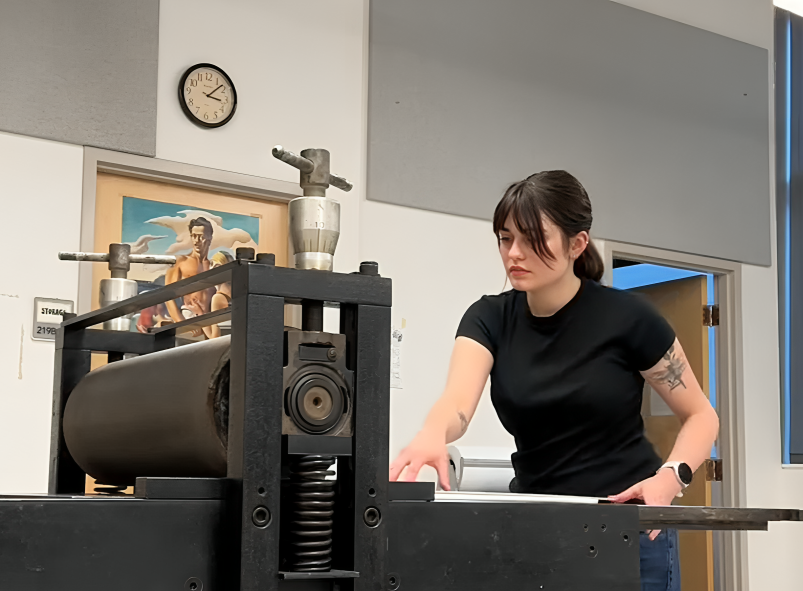
As a studio art major who explores several mediums, including printmaking, painting, sculpture and photography, Moira McCarthy has a unique stance on abstract art that stems from her personal connections to the artistic craft.

"As someone who is trying to do art for a living, [I like to do] more impressionist [styles] and also try to be more realistic with some pieces,” she said. “I tend to find that [non-objective art] does not require a lot of skill.”
McCarthy perceives the splatters of paint as vital to the evolution of visual expression. Though she is not drawn to the styles of Abex and its branches, she believes in the importance of intention and an exhibition of prowess.
She avoids outright judgment but remains critical of the person behind the piece. Abstract art is a style dominated by men, and she sees their ability to produce countercultural works as a pleasure that women are often exempt from.
“I was doing some research of other famous abstract artists that aren’t just men,” McCarthy said. “But you really have to dig to find [anyone].”
It is not a call for media censorship, as McCarthy does not seek to eliminate styles due to her personal preference. Art belongs in museums without the implementation of a hierarchy. She argues that abstract art must have discernible meaning so as to not celebrate someone who is undeserving of praise – “rich men” with free time.
“They've been put into a privileged position of where they're like ‘I can pass this as something bigger than it is,’” McCarthy said.

Samantha Baskind, professor of art history at Cleveland State, believes that abstract art is widely recognized as historically significant, but may not always appeal to modern audience’s tastes.
“In the mid-20th century, many viewers encountered it with skepticism or hostility, seeing it as obscure or elitist,” Baskind said. “Whereas today abstraction is institutionally validated and widely familiar through museums, education and the art market.”
Baskind finds that non-representational art shifts the way in which the viewer is tasked to observe the visual stimuli they are confronted with, rather than accepting the image at face value.
As abstract work exercises the muscles of the brain, opinions of it morph into complex discussions of artistic intent.
“[Art historians] value it for expanding what counts as artistic intention and visual language, while collectors and audiences respond to its capacity to register emotion and cultural context in nonliteral ways,” Baskind said.
Those who have not yet embraced the unconventional may find it beneficial to shift their perspective beyond what they immediately perceive upon observing a work of non-representational art. Meditate and note how “scale, texture, rhythm, density or spatial tension” might evoke an emotional response.
“Consider the artist’s choices – why this material, gesture, et cetera – and how those decisions might register within a particular historical moment,” Baskind said.
The purpose of abstraction is to withhold information and eliminate the need for reasoning, breaking artistic techniques into methods of connecting to the audience’s psyche. Paint and canvas no longer dictate the extent to which experiences speak through the work.
By embracing the discomfort that it raises, one can enter the conversation and abolish elitist interpretations of what art should accomplish. Generative artificial intelligence extinguishes the flame of human creativity by replicating the time-consuming practice of creation. Abstraction cannot be stolen, as it requires one element that a robot cannot obtain: life.
Explore artworks that ignite discomfort. Ignore expectations of grandeur and have a one-on-one with the artist; listen closely and discern bias from true emotional influence. If one finds a piece “ugly,” that gives more reason to embrace it.