Returning to Inconvenience
As music lovers reluctantly part with their streaming service subscriptions, it is crucial to provide alternatives that allow people to sustainably keep up with their favorite musicians and albums.
Written by Kylee Herrick
Amidst controversies surrounding the music streaming service, Spotify, individuals are coming to a stark realization that they may be paying too much for too little. Artists are pulling their content off of the platform, and users crave the means to escape. In the digital age, it is difficult to comprehend a world where one can listen to music without a subscription. All is not lost, as new methods of listening can be found that allow music to become a meaningful and purposeful experience.
PHYSICAL MEDIA
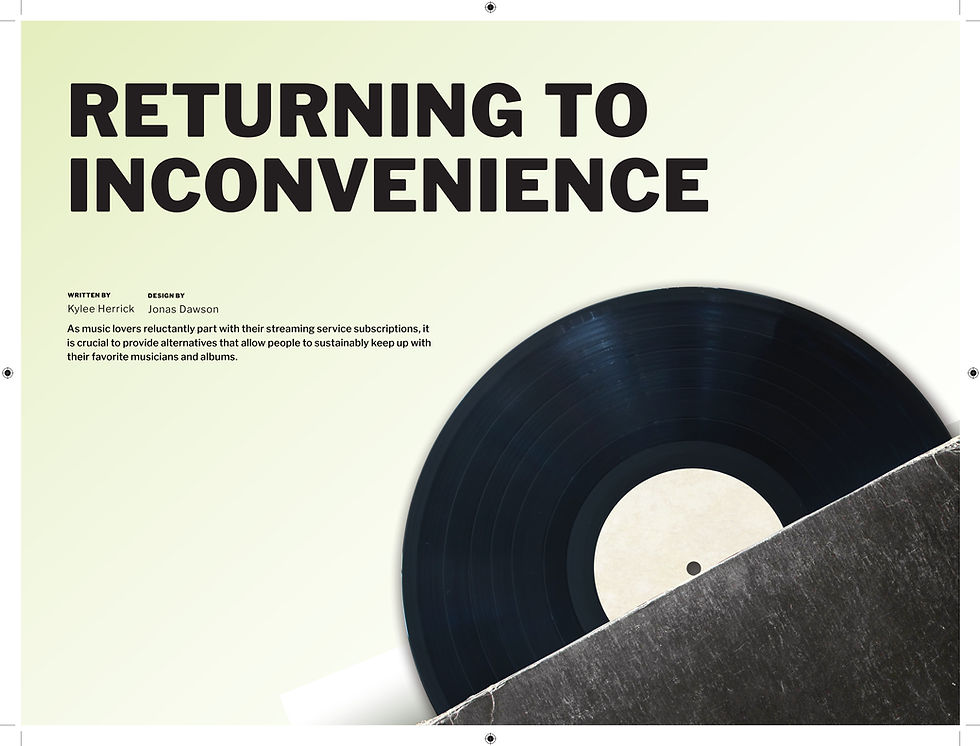
Interest in vinyl has risen prominently within the past decade, making it impossible to drive through the Northeast Ohio region without stumbling across a record store overflowing with physical copies of albums – including cassettes and CDs.
Commonly found albums run for reasonable prices. Starting a new collection or adding to an existing one is adequately affordable and creates a solid foundation for a music library. In regards to playing said vinyl, record players run from about sixty to four hundred dollars, but a high-end turntable is not necessary to produce a quality sound. Many aficionados recommend brands such as Audio-Technica and Victrola. Putting money towards a high-caliber turntable ensures it has the longest possible lifespan.
Cassettes are less sought after, but are effective if the budget is tighter. There are multiple systems that are capable of playing tapes; stereos, miniature cassette players and portable radios are often compatible. Digging through an old bin of cassettes at a local record store carries a level of excitement that cannot be found within the boundaries of a playlist.
CDs are the most accessible form of physical media. Because of its relatively young lifespan compared to vinyl and cassettes, CDs swarm garage sales and the neighborhood Goodwill at unbeatable costs. It is rare to find a stereo without a CD-playing function; many car models also feature CD receivers for on-the-go listening.
Custom CDs can be burned using a Mac or Windows computer system and directly downloading the MP3 files of the desired songs. If the device does not have a built-in disc drive, external drives are cheap and easy to find. Blank discs are widely available to purchase – in-person and online.
Vinyl, cassettes and CDs can be bought online when a record store is simply out of reach. Discogs is an online platform equipped with the ability to document a user’s collection and to buy physical albums from others. Used copies are cheaper and prevent a record from being lost to a landfill or attic.
DIGITAL MUSIC
If the idea of starting a physical collection overwhelms, music can be accessed digitally and stored neatly inside any given device.
Bandcamp is another platform dedicated to improving music accessibility. Through Bandcamp, users can directly support artists by purchasing digital – or tangible – copies of their music. Small bands frequently offer free downloads, while well-known bands may charge a meager ten dollars per album.
Regardless of the price, acquiring a digital album from Bandcamp denotes that the buyer owns that particular file; the code is their property. Thus, in the circumstance of a musical apocalypse, Fugazi will remain safe in its desktop folder. For every purchase of a vinyl or cassette copy, a digital download automatically becomes available – if the turntable is unreachable.
The platform notably implemented an event referred to as ‘Bandcamp Fridays,’ during the height of the COVID-19 pandemic, to support artists when venues were shut down. The tradition has continued to provide a way for musicians to keep the lights on. On select Fridays, the revenue share that Bandcamp receives is waived, allowing for the entire cut to be directly given to the artist and their label.
In a culture of subscription-based services, owning the content one consumes is a luxury. It is vital that the audience and the musician are connected without the third wheel of a corporation.
CONCERTS & EVENTS
Concert tickets for major artists continually rise each year, making the experience of live music feel beyond the scope of most people’s budgets. Cheap shows may raise eyebrows; there is an association that a low-cost ticket equates to a dingy, basement concert of violent mosh pits and sticky floors. What many fail to see are the abundance of local bands performing at legitimate Cleveland venues. These are the shows that will leave a lasting impact.
Those trying to remain cost-effective should avoid places such as Severance Music Center, House of Blues or Blossom Music Center. It is suggested to stick to venues that feature emerging artists and connect with the community through events and fundraisers.
Small locations, such as The Grog Shop and Beachland Ballroom & Tavern, hold space for a diverse array of performers and ticket prices that will not crush the poor university student. No matter if it is a band that the person is familiar with, taking the risk and seeking out local entertainment can evoke deeper emotions concerning music that would have otherwise gone unheard. It also supports the artist when an audience shows up to celebrate their talents and unique sound.
Despite what the internet may declare, musical culture has not disappeared. Intentional music consumption requires the first leap, to choose art over convenience. Once the vinyl collection starts it becomes impossible to return to an ever-increasing monthly fee.