


Where Women’s Sports Take Center Stage
In a city long dominated by traditional sports culture, The W Sports Bar is creating a space where women’s teams and their fans can feel seen, safe and welcome.
Written by Helaina Rucinski

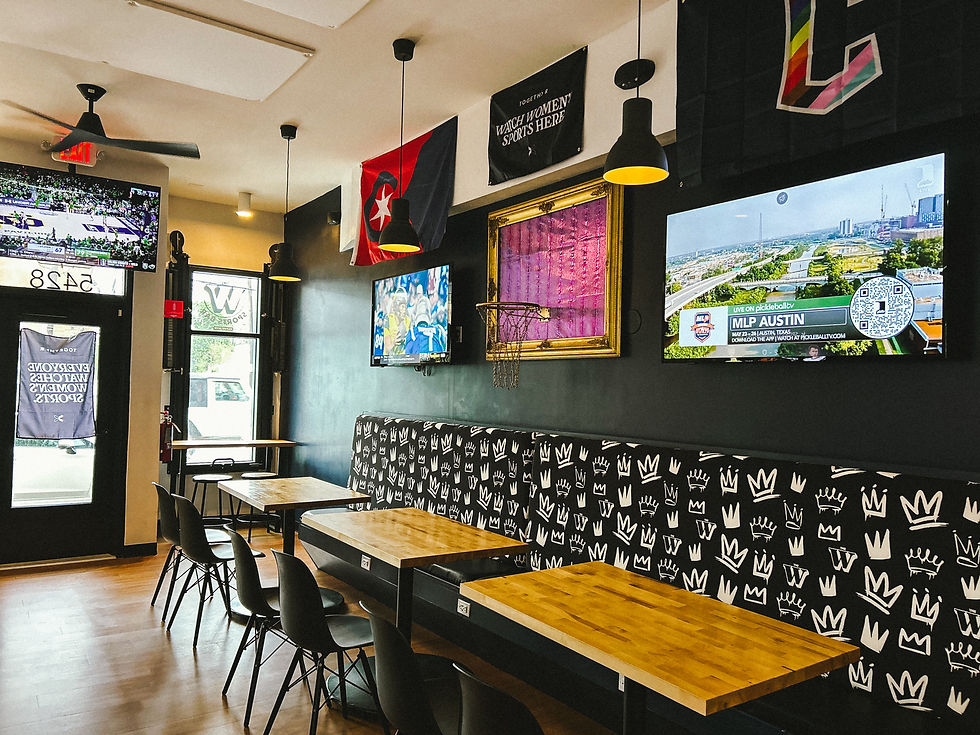
On any given night inside The W Sports Bar, the volume is up, jerseys are visible and cheers from fans come without hesitation. The screens aren’t on the expected default of men's games. Instead, WNBA matchups, NWSL games and NCAA women’s tournament showdowns take priority. Strangers cheer together. No one is being quizzed on stats to prove they deserve to be there. No one is asking for the remote to change the channel.
No one is surprised to see women’s sports on every screen.
The W Sports Bar opened May 1, 2025, and is Cleveland’s first and only women’s sports bar – founded by Ally Eclarin and co-owners Cassy Kopp and Shelley Pippin. Located in the Detroit-Shoreway neighborhood, the space was built to address something that has long been missing: a home for women’s sports fans.
As Eclarin put it, “fans have always been here.”
For years, she said, women’s sports fans found ways to watch games that weren’t necessarily prioritized. They streamed them quietly, searched for unreliable links or watched on their phones in corners of bars that refused to change the channel.
“We used to bootleg it and watch it in any way that we could,” she said.
She argues that the recent surge in coverage is not about the sudden emergence of talent, but about visibility – a distinction she explains through a music analogy.
“It’s kind of like you’ve always known the songs, you’ve always been a fan of the band, they’re just now being played on the radio,” Eclarin said.

Seeing the Gap
Eclarin grew up immersed in sports. She played throughout her youth, coached as an adult and remained a devoted fan long after leaving the field. But even as coverage expanded nationally, she noticed a local gap.
Time and time again, she found herself in sports bars that claimed to show everything – every league and every matchup – yet the screens stayed on the channels that televised men's games.
“As someone who believes in equality and equity, I just think that’s totally wild,” Eclarin said.
The issue wasn’t only about primetime matchups, it was about the everyday assumption that women’s sports were secondary. Something to request rather than expect.

For Emily Shelton, a Cleveland State University graduate student, that reality once meant watching a Women’s World Cup game on her phone because a bar refused to put it on a television.
“It was like the dead of summer,” Shelton said. “There was nothing really else on.”
Now, she doesn’t have to wonder whether the women's sports game she wants to watch will be shown.
“You don’t have to worry about, ‘Am I going to be able to actually see what I want to see?,’” she said.

Shelton began coming to The W within a week of its opening. By July, she was working there part time as a server and bartender while completing her master’s in health sciences at CSU.
Eclarin calls her the “epitome of a regular day one.”
Shelton said she was there so often that she started helping clean tables before she was even on payroll.
For her, the difference in The W compared to other sports bars was noticeable right away – not just in what was playing on the screens, but in how it felt to sit there.
“It was very affirming,” Shelton said.
How The W is More Than a Bar
Sports may be what brings people through the door, but it’s not the only reason they stay.
Eclarin describes The W as a “safe space,” a phrase that reflects what many women calculate every time they go out. Whether they’ll be harassed, questioned or made to feel small.
“You get a safe space where you don’t feel the need to cover your drink when you go to the bathroom,” Eclarin said. “Which we all do because, as women, we’re conditioned to do so.”

For Eclarin, that instinct is not unusual. It is routine. It is a learned behavior that many women follow without thinking twice.
“I know saying these things feels very intense,” she said. “But that’s the nature of many public establishments, whether you’re a woman or anyone in a marginalized group.”
That reality is exactly what The W set out to change. “That’s the gap we filled so people don’t have to feel that way anymore,” Eclarin said. “I want to watch my favorite teams at a bar where I feel safe,” she said.
Eclarin said too often, women are quizzed on their football knowledge or second-guessed about their fandom, as if enthusiasm requires proof.
“You don’t get that at The W,” she said.

The bar operates with a zero-tolerance policy toward hate or discrimination. Pride flags hang on the walls. Hiring is intentional. Expectations are clear. Respect is nonnegotiable.
“It’s the bare minimum: be a good person,” Eclarin said. “We don’t have time for hate.”
For many customers, that environment of acceptance is powerful.
“You don’t feel like you’re being made fun of or judged based on whose hand you’re holding when you walk in,” she said.
Shelton acknowledges the natural overlap between women’s sports fandoms and LGBTQ+ communities, but stresses that the space is intentionally open to everyone.
“It’s a place anyone can go,” Shelton said.
Families stop in for lunch. Students bring laptops. Shelton admits she has spent more hours than she can count studying organic chemistry at the bar counter – something that speaks to how different the space feels and confirms she is exactly where she belongs.

Flipping the Channel
Nationally, women’s sports are seeing record viewership and investment. Cleveland is preparing to welcome its own professional women’s basketball team, a development Eclarin views as both exciting and overdue.
“If I’m being totally honest…Cleveland is definitely headed in the right direction, but there’s a lot more work on that front,” Eclarin said.
Trends often arrive slower in some places, she said, but that doesn’t mean the appetite isn’t there.
What distinguishes The W is not that it is responding to change – it is accelerating it. By putting women’s sports on screen 365 days a year, the bar removes the idea that they are special events.
They are simply sports. They are simply worth watching.
For Shelton, imagining Cleveland without The W is difficult.
“It definitely would be missing a women’s sports collective space,” she said.
In a city where sports culture runs deep, that collective space now exists – one where women’s games are not an afterthought and women’s voices are not background noise.
Inside The W, the songs that fans have always known are no longer played quietly. They’re playing at full volume.


