


A meeting, a movement, a campus
At Cleveland State, a new student group is connecting activism, education, and community action.
Written by Sage Colón

Where it started
The first time Audrey Menner attended a student organizing meeting, they went alone.
“I tried to reach out to my friends, but no one else could go,” said Menner, a third-year English major at Cleveland State University. “So I was like, ‘Okay, whatever, I’ll go myself.’”
What they found at the Cleveland Liberation Center was more than just a meeting – it was the starting point for bringing a new student organization to campus.
Students for a Just Society at Cleveland State is part of a broader network of student-led groups across Northeast Ohio, but its presence on CSU’s campus began with a single meeting – and a single student.

In late January, following student protests at CSU and organizing efforts across the country, community organizers, including Amanda Yurick, a faculty member at Cleveland State University and faculty advisor for Students for a Just Society, began working to build student chapters across Cleveland-area schools. At one early planning meeting at the Cleveland Liberation Center, Menner was the only CSU student in attendance.
“I was the only CSU student in attendance, and I was the first to ever attend those meetings,” Menner said.
That meeting became a turning point. What was initially a space to learn quickly evolved into an opportunity to lead.
“They were like, ‘You might not think that you’re leaders, but you being here, you are leaders,’” Menner said. “And I was like, okay… sure.”
From there, Menner worked with Yurick to officially establish the Cleveland State chapter, recruiting officers and building the organization from the ground up.

A collective effort
Students for a Just Society focuses on connecting students with community organizations, activism and education. While each campus chapter operates locally, all members are connected through monthly meetings at the Cleveland Liberation Center, where students from different schools come together to share ideas, attend training sessions and collaborate.
“It’s not just one school, not just one student,” Menner said. “It’s a collective.”
Those meetings include workshops on protest organizing, public speaking and political education, along with discussions that help students better understand the issues they care about.

From Yurick’s perspective, that kind of student involvement is critical. “Students have always been on the leading edge of taking action for change when society requires change,” Yurick said.
For Menner, getting involved started with a desire to step outside their own experiences and learn more about the world around them.
“I didn’t really know how to get started,” they said. “I was like, I need to learn more.”
After growing up in a more sheltered environment, Menner said they wanted to better understand different perspectives and use their voice.
“I know I’ve got a lot of privilege…and I need to use my privilege,” they said.
Their first protest – a student walkout in Cleveland – became a defining moment.
“I was kind of tearing up because I was like, this is so awesome to see people come together for the same thing,” Menner said.
Those experiences, they said, continue to push them beyond their comfort zone and into community spaces.
“We live in such an individualist society,” they said. “But this is what it’s all about.”
A place to start
That sense of connection is something other members of the organization say they’ve felt as well.
Zoe Guilonard, a sophomore history and social studies education major and SJS club member, said the organization provides both purpose and community.
“In these times, it can feel so hopeless, so being able to do anything to make an impact can lift your spirit,” Guilonard said. “Afterwards, I always feel energized, rejuvenated and accomplished.”
Guilonard added that the group gives students a place to contribute and belong.
“People should join because it's a unique opportunity to give back to the community and find their place with people,” she said.
Menner said one of the organization’s biggest goals is to make activism feel accessible, especially for students who may be unsure where to begin.
“The only way to get started is to get started,” they said.
They described SJS as a space where students can take that first step together, without pressure or judgment.
“The point of the club is to have a group of people who will say, ‘Hell yeah, let’s go together,’” Menner said. “It’s supposed to be a place where there’s no judgment – where you feel less alone.”
Yurick echoed that idea, emphasizing the importance of collective action.
“The power that people have is actually in the community,” Yurick said.
While the organization is rooted in activism, Menner emphasized that it is not meant to be exclusive or rigid.
“I don’t want people to ever feel like it’s some type of exclusive club,” they said. “You don’t have to be a certain political alignment.”
Instead, they encourage students to explore multiple organizations and perspectives.
“Join all of them,” Menner said. “Go to all of them, meet all these people, learn more.”
For both Menner and Yurick, the idea of a “just society” is central to the group’s mission.
“It requires a complete overworking of what we have now,” Menner said. “Starting over and focusing on meeting people’s needs.”
Yurick described it more broadly, “a just society looks like when everybody has their needs met.”

What's next
As the Cleveland State chapter continues to grow, Students for a Just Society is already organizing ways for students to stay involved beyond the semester.
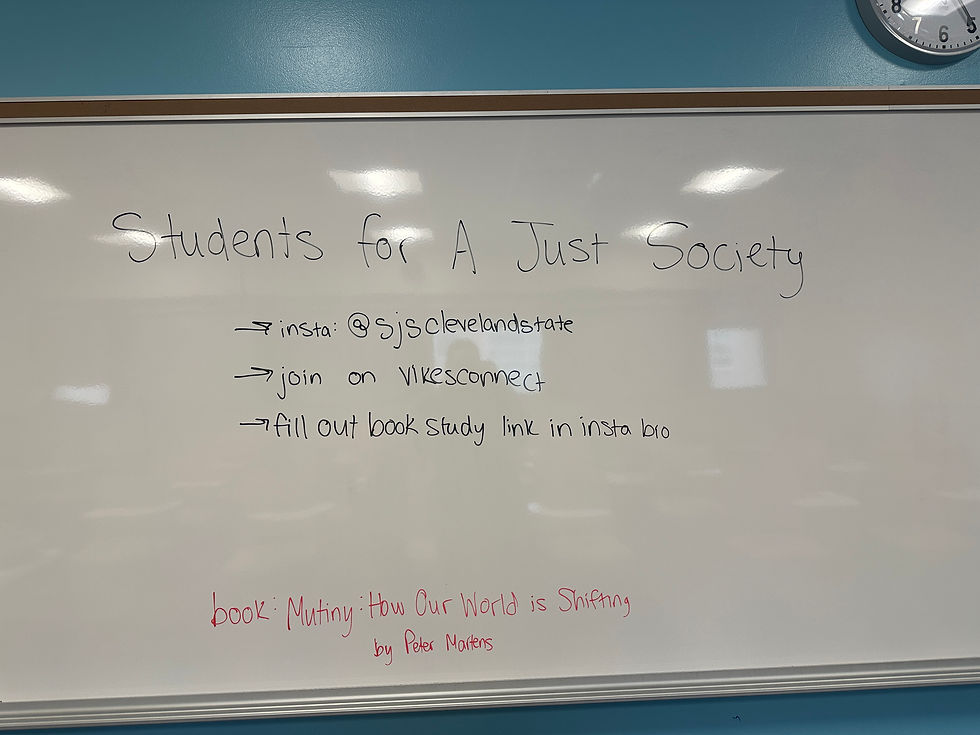
The group will host its first book study meeting May 14 at 4 p.m. via Zoom, focusing on “Mutiny: How Our World Is Shifting” by Peter Mertens.
Members are also working to participate in a Habitat for Humanity wall build later this spring and continue supporting Food Not Bombs through ongoing donation efforts.


